
Why Avoiding Difficult Conversations Is Costing Your Business
Every founder wants a strong team. But what happens when someone isn't performing, expectations aren't being met, and you avoid saying anything because you don't want to upset them?
More often than not, the problem doesn't resolve itself.
It grows.
One of the biggest lessons I've learned as a leader is that avoiding difficult conversations rarely protects people. It usually creates confusion, frustration and unnecessary work for everyone involved.
And it all comes back to a concept I learned almost a decade ago.
The Leadership Lesson That Changed How I Manage People
A few years ago, I read Radical Candor by Kim Scott.
This week, I had one of those surreal moments where I shared a story about the book on LinkedIn... and Kim Scott herself commented on it.
It was a proper fangirl moment.
Even better, she did exactly what she teaches. She offered me some gentle feedback on the story I'd shared.
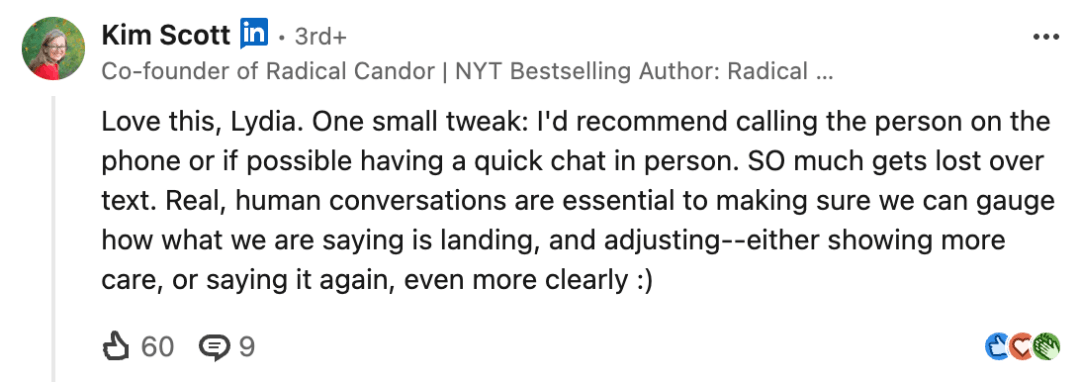
She suggested that where possible, feedback should happen over the phone or face-to-face rather than over text, because real conversations help us understand how our message is landing.
It was a brilliant reminder that radical candour isn't about saying difficult things. It's about caring enough to communicate well.
That small interaction reminded me why this book has had such a lasting impact on how I lead teams today.

What Is Ruinous Empathy?
Ruinous empathy happens when you avoid giving honest feedback because you don't want to hurt someone's feelings.
It often feels kind in the moment.
In reality, it usually creates bigger problems later.
Instead of helping someone improve, you leave them unaware that there's an issue. Expectations become unclear. Performance doesn't improve because nobody has explained what needs to change.
Meanwhile, as the founder, you quietly compensate.
You fix mistakes. You redo work. You carry extra responsibility.
Before long, you've increased your own workload instead of solving the actual problem.
This is one of the most common causes of founder overwhelm, especially in growing businesses.
Why Founders Avoid Difficult Conversations
Every single week I speak to founders who tell me they have a people problem.
When we dig into it, I nearly always ask the same question.
"Have you actually told them this is an issue?"
Nine times out of ten, the answer is no.
Not because they're bad leaders.
Because they're good people.
They don't want to upset someone. They don't want to knock confidence. They hope things will improve naturally.
I know that feeling because I've done exactly the same.
Earlier in my career, I had team members I genuinely respected and cared about. There were things that weren't working, but instead of addressing them, I stayed quiet.
I hoped things would improve on their own. They didn't.
Instead, I found myself working longer hours, picking up extra work and quietly filling the gaps.
One honest conversation could have saved weeks of unnecessary stress.
Why This Matters for Scaling a Business
If your business depends on you constantly stepping in, it becomes incredibly difficult to scale profitably.
Avoiding conversations creates operational problems that spread throughout the business.
People become unsure of expectations. Standards become inconsistent. Managers hesitate to address issues.
Founders become the safety net for everything.
This isn't just a communication problem. It's an operations strategy problem.
Healthy businesses are built on operational clarity.
That means people know:
What success looks like.
What they're accountable for.
When something isn't meeting expectations.
How feedback is given consistently and constructively.
These are the business systems for growth that allow you to scale without doing everything yourself.
How Do You Give Honest Feedback Without Damaging Relationships?
The goal isn't to criticise people. It's to help them succeed.
Good feedback is:
Timely. Don't wait weeks hoping the issue disappears.
Specific. Talk about the behaviour or outcome, not the person.
Clear. Remove ambiguity so people know exactly what needs to change.
Supportive. Give them the opportunity and tools to improve.
Most people would rather know where they stand than spend months unknowingly getting something wrong.
That conversation is often far kinder than silence.
A Small Example That Reinforced This for Me
This week I was interviewing a candidate.
She completely misunderstood one of my questions.
I could have let her continue answering something I hadn't asked. Instead, I stopped her.
I explained that I didn't think I'd asked the question clearly enough and gave her the opportunity to answer again.
She immediately understood. She gave a far stronger answer.
The interview became a much fairer reflection of her ability.
That wasn't about criticising her.
It was about giving her the chance to succeed.
Sometimes the kindest thing you can do is address things.
A Founder's Playbook for Practising Radical Candour
If you've been avoiding a conversation, here's where I'd start.
1. Identify the conversation you've been putting off
There's usually one.
The team member who's struggling.
The repeated mistake.
The behaviour you've quietly worked around.
Write it down.
2. Ask yourself what you're protecting
Are you protecting them?
Or are you protecting yourself from an uncomfortable conversation?
Those are two very different things.
3. Be clear before you speak
Know exactly:
What happened.
Why it matters.
What needs to change.
What good looks like moving forward.
Clarity makes difficult conversations much easier.
4. Have the conversation early
Don't wait until frustration builds.
Small issues are much easier to solve than patterns that have continued for months.
5. Back it up with structure
Feedback works best when expectations already exist.
Clear roles, documented processes, regular one-to-ones and consistent accountability all create the operational clarity that helps people perform well.
Where to Focus First
If this resonated, think about the conversation you've been avoiding.
Ask yourself whether staying silent is actually helping the other person, or whether it's quietly increasing your own workload.
Often, the fastest way to reduce overwhelm as a business owner isn't working harder. It's creating the clarity your team needs to succeed.
This is exactly the kind of work I support founders with through operations strategy, helping businesses build the structure, systems and leadership habits needed to scale profitably and scale without doing everything yourself. You can find out more about my operations strategy support for founders.
Join Monday Mover
If this resonated, you can join my Monday Mover newsletter for a weekly dose of strategy, systems and straight-talking insight to help you build a business that grows without relying on you for everything.

Lydia Hawkridge
The Operations Bestie™
I help business owners untangle the operational side of growth by identifying the gaps, bottlenecks, unclear systems and inconsistent processes that can prevent businesses from scaling sustainably.
Stronger operations create stronger foundations for growth. You can explore my operational support services here.
